Ready to buy? Check current prices on Amazon and compare deals before you decide.
Bacopa monnieri is an herb that has garnered interest for its potential supportive properties, particularly for cognitive well-being. As women navigate the midlife and menopausal transitions, understanding how to best incorporate supplements like Bacopa monnieri can be a helpful consideration.
One aspect of supplement use that often arises is how to maximize the body’s ability to utilize the active compounds. Bacopa is widely said to absorb better when taken with dietary fat. That advice deserves a close look, because the chemistry usually offered to justify it does not hold up, and the comparison has never been measured in people.
Understanding Bacopa Monnieri’s Active Compounds
The beneficial properties of Bacopa monnieri are primarily attributed to a group of active compounds known as bacosides. These bacosides are triterpenoid saponins, and their unique chemical structure plays a role in how they interact with the body.
Bacosides are not fat-soluble compounds. Bacoside A is a mixture of dammarane-type triterpenoid saponins built from a steroid-like aglycone skeleton with sugar chains attached to it[1]. Those sugar chains are the defining feature. They make the intact bacoside a large, highly polar molecule rather than a fat-loving one. Saponins as a class are amphiphilic, meaning one part of the molecule associates with fats and another with water, which is why they foam in water like a natural detergent. Calling bacosides lipophilic, in the sense that vitamins A, D, E and K are lipophilic, misstates what they are.


The Digestive Process and Fat-Soluble Compounds
When we consume food or supplements, our digestive system works to break them down and absorb their components. Water-soluble compounds typically dissolve in the watery environment of the digestive tract and are absorbed directly into the bloodstream. Fat-soluble compounds, however, follow a different pathway.

For genuinely fat-soluble substances, the presence of dietary fat stimulates the release of bile acids in the small intestine. Bile acids act as emulsifiers, breaking fats into smaller droplets, so that fat-soluble compounds can be incorporated into micelles and carried across the intestinal lining into the lymphatic system. That is the established route for the fat-soluble vitamins. It has not been shown to be the route for bacosides.
Without sufficient dietary fat, that emulsification step is less efficient for the compounds that depend on it. The point to keep straight is that bacosides are not among those compounds, so the principle does not carry over to them.
Bacopa Absorption and Bioavailability
Absorption refers to the process by which substances enter the bloodstream from the digestive tract. Bioavailability, a related concept, describes the proportion of a substance that enters the circulation and is able to have an active effect. For Bacopa monnieri, optimizing absorption is a step towards potentially improving its bioavailability.
No published human trial has compared bacoside absorption with and without dietary fat, and chemistry is not a substitute for the missing measurement. What the research does document is that intact bacosides absorb poorly on their own. An analysis of their molecular properties found the parent bacosides had poor drug-like characteristics and could not engage the cognitive receptors tested, while their aglycones, the same molecules with the sugar chains removed, were well absorbed through the intestine and crossed into the brain[1]. The authors proposed that bacosides are converted in the body before becoming active. On that picture the limiting step is the size and polarity of the intact molecule and its conversion, not how much fat was in the meal.

Taking Bacopa monnieri with a meal is still reasonable, but the usual reason given for it does not survive scrutiny. The better reason is tolerability: bacopa is well known to cause stomach upset, cramping and loose stools in some people, and food tends to blunt that. Framing a meal as an absorption booster promises a benefit that has not been demonstrated.
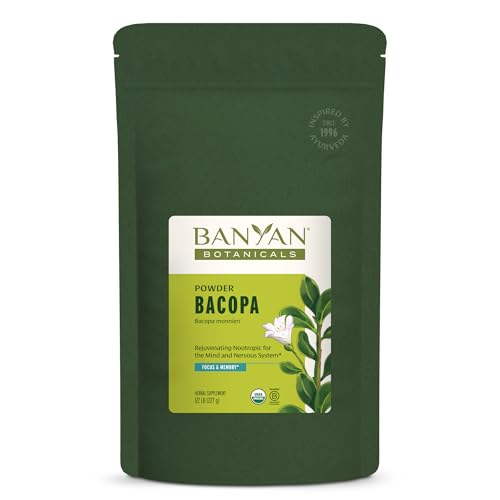
Practical Tips for Taking Bacopa Monnieri
With that distinction in mind, here are practical considerations for women incorporating Bacopa monnieri into their daily routine during midlife and menopause:
Consider taking your Bacopa monnieri supplement with food if it bothers your stomach on its own. The meal does not need to be built around fat for this purpose, and there is no evidence that adding avocado, nuts or olive oil to it increases how much bacoside you absorb. Choosing a standardized extract and staying on it long enough matters far more than what you eat alongside it.
Consistency is also key. Establishing a regular routine for taking Bacopa monnieri, ideally at the same time each day, may help maintain more consistent levels of its active compounds in the body. The clinical trials that found an effect dosed daily for twelve weeks, so duration is the variable that has actually been tested.
Evidence Strength and Considerations
There is no direct evidence that taking bacopa with dietary fat increases how much bacoside reaches the bloodstream. No human trial has measured absorption at different fat intakes, and the common explanation, that bacosides are lipophilic and so behave like the fat-soluble vitamins, does not match what they are[2]. In the literature, improving bacopa absorption is treated as a formulation problem: reviews of bacoside pharmacology point to nanoscale delivery systems as the route to better uptake and brain penetration, rather than to anything on the plate beside the capsule[3].
It’s important to remember that individual responses to supplements can vary. Factors such as digestive health, overall diet, and individual metabolism can all influence absorption and how a person responds to Bacopa monnieri.
References
- In Silico and In Vitro Analysis of Bacoside A Aglycones and Its Derivatives as the Constituents Responsible for the Cognitive Effects of Bacopa monnieri. PLoS One, 2016
- Bacopa monnieri: Preclinical and Clinical Evidence of Neuroactive Effects, Safety of Use and the Search for Improved Bioavailability. Nutrients, 2025
- Insights Into the Molecular Aspects of Neuroprotective Bacoside A and Bacopaside I. Current Neuropharmacology, 2019
These statements have not been evaluated by the Food and Drug Administration. This information is not intended to diagnose, treat, cure, or prevent any disease. Content is for informational purposes only and is not medical advice; consult a qualified healthcare provider before starting any supplement. As an Amazon Associate we earn from qualifying purchases.
